Reading a history essay where every sentence starts with "The..." and follows the same pattern can make even the most dramatic events feel flat. Varying your sentence structure when writing about historical events keeps readers engaged, strengthens your arguments, and makes your writing feel confident rather than mechanical. It's a skill that separates clear, compelling historical writing from text that reads like a timeline nobody asked for.
What does it mean to vary sentence structure in historical writing?
Varying sentence structure means changing how you build sentences across a paragraph or page. You mix short sentences with long ones. You switch up where the subject appears. You alternate between active and passive voice. You change your sentence openers so every line doesn't start the same way.
In historical writing, this matters even more than in other genres. History involves sequences of events, names, dates, and cause-and-effect relationships. If you use the same sentence pattern to describe each event "This happened. Then that happened. Then another thing happened." your reader loses the thread, no matter how interesting the content is.
Why does repetitive sentence structure make historical writing harder to read?
When every sentence follows an identical pattern, the reader's brain starts to tune out. The rhythm becomes predictable. Important details get buried in the monotony. A key turning point in a war or a surprising political shift deserves a sentence that feels different from the routine background information around it.
Think about it this way: if you describe a peaceful trade agreement and a devastating battle using the exact same sentence length, structure, and tone, you're sending the wrong signal. The structure itself should reflect the weight of what you're describing.
How can you change sentence length to improve your historical writing?
This is one of the simplest and most effective techniques. Follow a long, detailed sentence with a short one. The contrast creates emphasis.
Here's an example:
Before: "The French Revolution began in 1789 when the people of France rose up against the monarchy because of widespread poverty and inequality that had persisted for decades under the reign of King Louis XVI."
After: "Widespread poverty and decades of inequality had pushed France to its breaking point. In 1789, the people rose up. The monarchy would never recover."
The second version uses three sentences instead of one. The short final sentence "The monarchy would never recover." hits harder because of its length. If you want to see more ways to restructure historical sentences, these examples of rephrased historical sentences walk through the process step by step.
When should you use passive voice in historical writing?
Many writing guides say to avoid passive voice. That's good general advice, but historical writing is a bit different. Sometimes the person or group affected by an event matters more than the one who caused it. In those cases, passive voice works.
Active: "British soldiers fired on the crowd in the Boston Massacre."
Passive: "Five colonists were killed by British soldiers in the Boston Massacre."
Both are valid. The passive version emphasizes the victims. The key is to not rely on passive voice for every sentence. Mix it with active constructions so your writing stays direct and varied.
What are effective sentence openers to rotate in historical writing?
If you notice that most of your sentences start with a subject a person, a country, a year try rotating these alternatives:
- Prepositional phrases: "By 1945, the war in Europe had ended." / "During the Industrial Revolution, factory work replaced farming."
- Participial phrases: "Facing economic collapse, the Weimar Republic struggled to maintain order." / "Inspired by Enlightenment philosophy, the American colonists declared independence."
- Adverbs: "Eventually, the Ottoman Empire began to decline." / "Surprisingly, the treaty held for over a decade."
- Dependent clauses: "Although the assassination of Archduke Franz Ferdinand seemed small at the time, it triggered a global conflict."
- Time markers: "In the months that followed, alliances shifted rapidly."
For academic papers specifically, a historical vocabulary tool designed for academic writing can help you find precise language that fits your sentence openers without sounding repetitive.
What common mistakes do people make when trying to vary sentence structure?
Here are the errors that come up most often:
- Overcorrecting with fragments. Adding sentence variety doesn't mean writing incomplete sentences. "The war. Ended. Finally." isn't varied it's just choppy.
- Using complex words to sound varied. Swapping simple words for fancy synonyms doesn't change your structure. "The conflict commenced" has the same pattern as "The war began."
- Varying for the sake of variety. If a straightforward sentence works, don't twist it into something awkward just to be different. Variety should serve clarity, not compete with it.
- Ignoring paragraph-level rhythm. You might vary sentences within a paragraph but then start three paragraphs in a row with "In 17XX..." Structure variety should work at every level.
- Mixing too many ideas in one sentence. Some writers try to combine ideas to create longer sentences, but the result is confusing. A long sentence should still express one clear thought.
How do you vary structure when describing a sequence of historical events?
This is where most writers struggle. When events follow a timeline, the temptation is to write: "First... Then... After that... Next... Finally..." Here are better approaches:
Group events by theme instead of chronology. Rather than listing each event in order, cluster them by cause, region, or consequence. This naturally breaks up the sentence pattern.
Use different grammatical structures for transitions. Instead of "Then" at the start of every sentence, try embedding the time reference: "The fall of Constantinople in 1453 decades after the siege had first begun reshaped European trade routes."
Alternate between summary and detail. Give a broad overview sentence, then zoom in on a specific moment. "The civil rights movement spanned decades of organized resistance. On a single day in August 1963, a quarter of a million people gathered at the Lincoln Memorial."
If you need help expanding your descriptive vocabulary for these moments, these advanced vocabulary alternatives for historical descriptions offer practical options beyond the usual words.
Can you show a before-and-after example?
Here's a passage about the fall of the Roman Empire, written first with repetitive structure, then revised:
Before:
"The Roman Empire faced many problems in the 4th century. The economy was declining. Military pressure from barbarian tribes was increasing. Political instability weakened the government. The western half of the empire fell in 476 AD."
After:
"By the 4th century, the Roman Empire was buckling under pressure from every direction. The economy had stalled. Barbarian tribes pushed harder against its borders with each passing year. At the center of it all, political instability made effective leadership nearly impossible. In 476 AD, the western half collapsed not with a single dramatic event, but after decades of slow erosion."
The revised version mixes sentence lengths, uses different openers, varies voice, and avoids the repetitive subject-verb pattern. The information is the same. The reading experience is completely different.
Quick checklist: Does your historical writing have enough sentence variety?
- Read your work aloud. If it sounds monotonous, your structure needs work.
- Check your first three sentences. Do they all start the same way?
- Look for two or more sentences in a row with the same length. Change at least one.
- Count your passive and active sentences. Aim for mostly active with purposeful passive use.
- Replace at least one chronological transition ("then," "next") with an embedded time reference or a different transition type.
- Make sure at least one sentence in every paragraph is noticeably shorter or longer than the rest.
- Ask yourself whether the structure matches the weight of the content important moments should read differently than background details.
Start by picking one paragraph from something you've already written and rewriting it using two or three of these techniques. You'll see the difference immediately and so will your readers. For further reference on sentence-level writing strategies, Purdue OWL's guide on sentence variety is a reliable resource worth bookmarking.
 Historical Event Synonyms for Academic Writing and Research Papers
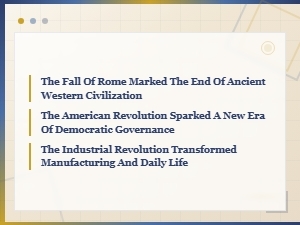 Examples of Rephrased Historical Event Sentences for Presentations
 I Need to Generate a Page Title Based on the Keyword and Category. the Keyword Is
 Historical Vocabulary Alternatives: Advanced Words for Describing Events
 Sentence Rewriting Techniques for Historical Narratives and Storytelling
 Tone Variation Exercises for Historical Event Paragraphs