When you write about the fall of the Roman Empire, the signing of the Magna Carta, or the D-Day landings, the words you choose shape how readers understand those moments. Repeating "happened," "important," and "changed" throughout your essay or presentation makes even the most dramatic events sound flat. Finding advanced vocabulary alternatives for historical event descriptions gives your writing precision, depth, and a sense of authority that basic word choices simply can't deliver. This matters whether you're drafting an academic paper, preparing a lecture, or crafting a history podcast script.
What does it mean to use advanced vocabulary when describing historical events?
It means replacing vague or overused words with terms that carry specific meaning. Instead of saying "The war caused problems," you might write "The war precipitated widespread economic destabilization." The difference isn't about sounding fancy it's about telling the reader exactly what kind of problems and how they unfolded. Academic historical writing, in particular, relies on this kind of lexical precision to distinguish between correlation and causation, between gradual shifts and sudden ruptures.
Strong historical vocabulary includes words that describe the nature of events (revolution, upheaval, consolidation), the pace of change (gradual, abrupt, incremental), the scale of impact (localized, widespread, systemic), and the relationships between causes and effects (precipitated, catalyzed, exacerbated). When you build fluency across these categories, your descriptions gain texture.
Why do writers keep defaulting to weak verbs and vague adjectives?
Most writers fall into repetitive language because of habit, not lack of knowledge. When you're deep into a 5,000-word paper on the French Revolution, it's easy to write "caused" fifteen times without noticing. The English language offers dozens of near-synonyms for "caused" alone each with a slightly different shade of meaning but under time pressure, the brain reaches for the first word available.
Another common trap is overcompensation. Some writers, aware that they need stronger vocabulary, stuff their sentences with impressive-sounding words that don't quite fit. Saying "The assassination of Archduke Franz Ferdinand galvanized the geopolitical landscape" works. Saying it "galvanized the geopolitical ecosystem" starts to sound hollow. Precision beats complexity every time.
If you're working on structuring your historical descriptions more effectively, learning how to vary sentence structure alongside your word choices can prevent the kind of monotonous prose that even strong vocabulary can't fix on its own.
Which words actually replace common overused terms?
Here are practical swaps organized by the words historians and students most commonly overuse:
Instead of "happened" or "occurred"
- Transpired suggests events came to light or unfolded over time
- Ensued indicates what followed as a direct consequence
- Unfolded conveys a sequence rather than a single moment
- Materialized implies something anticipated finally came to pass
- Commenced signals the beginning of a defined process or event
Instead of "caused" or "led to"
- Precipitated suggests a sudden trigger for a larger outcome
- Catalyzed implies an accelerating effect on something already developing
- Provoked carries a sense of deliberate or emotional triggering
- Gave rise to works well for long-term structural changes
- Exacerbated means worsened an existing condition, not created a new one
Instead of "important" or "significant"
- Consequential emphasizes lasting effects
- Seminal describes events that influenced everything that followed
- Defining marks a moment that shaped an era or identity
- Landmark signals a widely recognized turning point
- Fateful adds weight and often a sense of inevitability
Instead of "changed" or "transformed"
- Altered the trajectory of more specific about direction of change
- Reshaped implies structural reorganization
- Upended conveys disruption of established order
- Reconfigured works well for political or territorial changes
- Overhauled suggests thorough, intentional reform
Instead of "war" or "conflict" (when describing specific types)
- Civil unrest internal disorder short of full-scale war
- Insurrection organized uprising against authority
- Campaign a series of military operations toward a goal
- Hostilities formal term often used in diplomatic contexts
- Siege prolonged military blockade of a position
For a broader collection of near-synonyms organized for academic writing, this synonym finder built for academic papers covers additional context-specific alternatives.
How do you choose the right alternative in context?
The best vocabulary choice depends on three things: accuracy, tone, and audience.
Accuracy comes first. "Catalyzed" and "precipitated" are not interchangeable. If an existing trend was accelerated by an event, use catalyzed. If a sudden event triggered something unexpected, use precipitated. Misusing a sophisticated word damages your credibility more than using a simple one correctly.
Tone matters second. An academic thesis calls for different register than a public history blog. Words like "seminal" and "consequential" fit scholarly writing naturally. In a podcast script or popular article, "watershed moment" or "turning point" might land better with your audience.
Audience determines density. Flooding a paragraph with advanced vocabulary creates confusion, not sophistication. A good rule: use precise, elevated vocabulary for your key analytical claims and keep connective language simple. Your reader should notice your argument, not struggle with your word choices.
What are the most common mistakes people make with historical vocabulary?
Using words without checking their exact meaning. "Enervate" means to drain energy, not to energize. "Noisome" means foul-smelling, not noisy. Historical writing demands precision a misunderstood synonym can accidentally reverse your meaning.
Choosing words based on how they sound rather than what they mean. "Ubiquitous" sounds impressive, but if you're describing an event that happened once, it's the wrong word entirely. Let meaning drive your selection, not phonetics.
Ignoring connotation. "Regime" and "government" can describe the same entity, but they carry very different implications. "Massacre" and "battle" describe different moral framings of the same event. Your word choice reveals or conceals your interpretive stance.
Overloading a single sentence. Writing "The seminal precipitating factor that catalyzed the inexorable disintegration of the empire" buries the reader. Pick one strong modifier, not three.
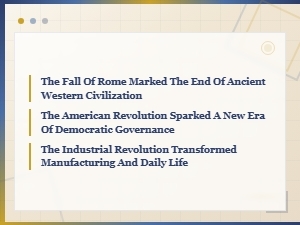
When presenting these ideas to an audience, it helps to see how others have handled similar rephrasing challenges the rephrased sentence examples for presentations show before-and-after comparisons that illustrate these principles clearly.
What practical steps can you take right now to improve your historical writing vocabulary?
Building a richer vocabulary for historical descriptions doesn't require memorizing a dictionary. It requires deliberate practice and the right resources. According to writing research published by the Harvard College Writing Center, vocabulary grows most effectively through wide reading and active experimentation rather than rote memorization.
Here's what actually works:
- Read respected historians and take notes on their word choices. Authors like Eric Hobsbawm, Mary Beard, and Timothy Snyder model precise historical language naturally.
- Keep a running list of "upgrade" words. When you catch yourself writing "caused," pause and consult your list for a more specific alternative.
- Use a thesaurus but verify every suggestion. A thesaurus gives you options; a dictionary confirms they fit your meaning.
- Read your sentences aloud. Awkward vocabulary becomes obvious when spoken. If you stumble over your own sentence, your reader will too.
- Replace one weak word per revision pass. Don't try to overhaul your entire vocabulary in a single draft. Make incremental improvements across multiple edits.
Quick-reference checklist before you submit your next history paper
- ☐ Have I searched for repeated words like "caused," "happened," "important," and "changed"?
- ☐ Does each advanced vocabulary word I chose match the exact meaning I intend?
- ☐ Have I considered the connotations of my word choices, not just their definitions?
- ☐ Is my vocabulary density appropriate for my target audience?
- ☐ Did I vary my sentence structure to complement my word choices?
- ☐ Have I read at least one paragraph aloud to check for natural flow?
- ☐ Would replacing any word with a simpler alternative actually improve clarity?
Start by picking one section of your current draft just one and replacing every vague or repeated word with a more precise alternative. That single pass will teach you more than any word list ever could.
 How to Vary Sentence Structure When Writing About Historical Events
 Historical Event Synonyms for Academic Writing and Research Papers
 Examples of Rephrased Historical Event Sentences for Presentations
 I Need to Generate a Page Title Based on the Keyword and Category. the Keyword Is
 Sentence Rewriting Techniques for Historical Narratives and Storytelling
 Tone Variation Exercises for Historical Event Paragraphs